Monday, 20 February 2012

Photography

My friends are curating a show this weekend at a gallery, and I am submitting some photos to be put up. I chose a selection and I wanted to share them on my blog.

I went to China last October on an exchange program, and was lucky enough to experience firsthand Chinese culture. It was interesting, but totally different to anything I've ever experienced before. As well as lingual and cultural oppurtunities, China presented many photographic oppurtunities:


I also chose some photos from my recent trip to the Bahamas last week:


Tuesday, 24 January 2012

Christo and Jeanne-Claude: Wrapped Reichstag


As I have been studying architecture, I have been researching many different architects. While this has been interesting, I thought it could also be exciting to take a new approach to the title, and look at Christo’s work. Although not an architect per say, Christo’s work wrapping buildings definitely links to the ideas of art and architecture, while taking a new, original approach. With work including the wrapping of the Pont-Neuf Bridge in Paris, the 24-mile-long Running Fence in California, The Gates in New York City’s Central Park, and Surrounded Islands in Miami, Christo is highly accomplished. His piece most relating to architecture though is the Wrapped Reichstag in Berlin, and I find this project one of his best.

The Gates 
Surrounded Islands
Pont Neuf Bridge
Running Fence


The Reichstag building is one of Berlin’s most historical landmarks. Opened in 1894, it housed the German Reichstag until 1933, when a fire severely damaged the building. During Germany’s separation, East Germany’s parliament met in the Palace of the Republic, while West Germany’s parliament met in the Bundeshaus in Bonn, and so the Reichstag continued to be neglected. It was not until the reunification of Germany in October 1990, that the Reichstag building underwent construction, and once again became the seat of the German parliament. 


Christo and his wife, Jeanne-Claude, pressed to wrap the building from 1971, after receiving a postcard proposing the idea from Berlin historian, Michael Cullen. It was only in 1994 that a close vote in parliament finally gave them permission to wrap the building. The wrapping began June 17th, 1995, and was completed by June 24th. The piece remained wrapped on display until July 7th. 


Although only on display for a brief two weeks, this art transformed one of Germany’s most important national symbols. By wrapping the Reichstag, the intricate details of the structures were hidden, and the overall shape was left behind. The silver material highlights the features and proportions of the imposing structure, revealing the essence of the Reichstag building. Once wrapped, the building takes on a new identity, as the imposing and solid structure becomes airy and nomadic. One of my favourite, and certainly one of his best-known pieces, the Wrapped Reichstag by Christo is an incredible piece of art, cultural event and political happening, all in one.


Friday, 20 January 2012

Paul McCarthy: The King, The Island, The Train, The House, The Ship

Last weekend, I visited the Hauser & Wirth gallery in Piccadilly, where sculptures and installations by Los Angeles-based artist, Paul McCarthy, were on exhibition. McCarthy's videos, sculptures and performance works throughout his career are known for pushing the boundaries of acceptability, testing the emotional limits of both the artist and the viewer. McCarthy never does anything under-the-top, whether painting with his penis in 1974 or inserting a Barbie doll into his rectum in his piece “Class Fool” in 1976. Yet it was still shocking when I walked into the South gallery of Hauser & Wirth on Saville Row to see his piece entitled, “Train, Mechanical”.

“Train, Mechanical” shows two pot-bellied caricatures of George W. Bush, sodomising two pigs. Repulsive and yet somehow tempting, the work invites you closer to inspect every detail and mechanism. Once there, the viewer becomes conductor, as George Bush’s oversized head and his beady eyes follow the viewer around the space. Squeals from the pigs and the motorised wheeze of pistons accompany the sculpture, making you feel even more uneasy as you view the piece (if that were even possible). To be perfectly honest, I wasn't sure whether to laugh or cry at the spectacle, but I can tell you I was definitely disturbed!

In the North Gallery of Saville Road, viewers climb up ladders to survey
“Pig Island”, a work that took McCarthy seven years to complete. “Pig Island” blurs the boundaries between a work piece and the workplace. Constructed on blocks of polystyrene, the island is littered with wood, ruined casts, leftover art materials, shelving units, spray paint and rotting fast-food containers, and is surrounded by a sea of blue carpeting. The island is populated by political and popular figures, by the likes of Angelina Jolie, George W. Bush and the artist himself, all in the centre of a wild and reckless abandon. Its state of chaos and its unfinished nature makes it seem like it could expand into infinity. 

After speaking to one of the men working at the gallery, I learned that through “Pig Island”, McCarthy wanted to convey the deformity and corruption at the heart of the American family. Unlike the picture-perfect Disney fairy tales McCarthy so often references, ‘Pig Island’ flaunts its unfinished state and mechanisms, critiquing the underbelly of the American dream.

Wednesday, 18 January 2012

Picasso’s African Period (1906-1909)

As the French empire was expanding into Africa, African artefacts were being brought back to Parisian museums. This aroused curiosity in African carvings and masks. Naturally, African culture and art influenced some of Picasso’s pieces in this time.

Picasso famously incorporated African influences into his work in Les Demoiselles d'Avignon (1907)


The figures on the right of this painting are inspired by African masks, with their striped and oval forms. His harsh geometric lines have mask-like qualities. Picasso painted their faces with earth tones, typical of African sculpture. The contrast between the femininity on the one hand and the African masks on the other hand is shocking, and exaggerates the mask-like faces further.

Some of Picasso’s other pieces inspired by African masks include:

Head of a Woman (1907)
Bust of a Woman (1909)
Nude with Raised Arms (1907)
Three Women (1908)
As a lot of Picasso’s work was influenced by African art, particularly masks, I thought it would be interesting to make a mask inspired by Picasso’s work in response:

 
Bust of a Woman with a Hat (1962)

I paper-mached my mask using coloured tissue paper and part of a cardboard box I found in someone's recycling on the way back from the art shop (fate!). I then decorated using markers and glitter glue. 


Sunday, 15 January 2012

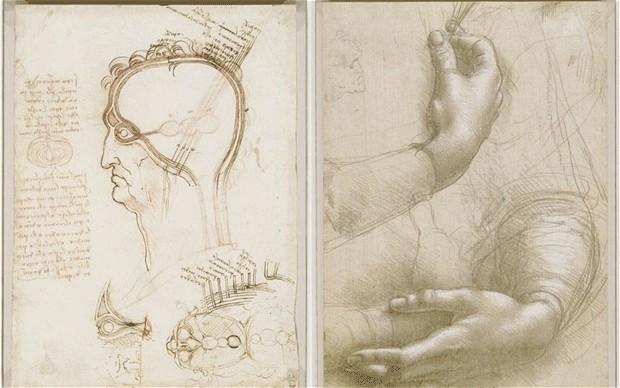
Leonardo da Vinci: Painter at the Court of Milan


Unquestionably the most anticipated exhibition of the year, ‘Leonardo da Vinci: Painter at the Court of Milan’ has completely sold out of advance tickets and is nearly impossible to get a ticket to: some art lovers lining up for the tickets from before dawn, others paying a fortune to scalpers. Fortunately for me, one of my best friends managed to secure five tickets, and invited me along with her. Her mother paid a student at my school to line up for the tickets from 6am, and that money will go towards the same student’s plan to build a school in Africa this summer- truly an inspirational project.

‘Leonardo da Vinci: Painter at the Court of Milan’ is the most complete display of da Vinci’s paintings ever held. The exhibition brings together about half of the surviving 15 or so paintings by da Vinci and features many more drawings by the legendary artist. The paintings include his acknowledged masterpiece The Lady with an Ermine and two versions of The Virgin of the Rocks, hanging together for the first time. The Portrait of a Musician, La Belle Ferronniere and Salvator Mundi (only recently authenticated as Da Vinci) are also featured. The exhibition focuses on the work da Vinci produced in his formative years as court painter to Duke Lodovico Sforza in Milan in the late 1480s and 1490s.

I really enjoyed this exhibition. It was arranged and presented thoughtfully, as we are able to see da Vinci’s preparatory sketches leading up to each of his paintings, and so get an insight into how each painting came about and the thoughts Leonardo had in creating each. The sketches, tiny in size, ask to be minutely examined, and reveal details in them which we don't normally recognise without such attention.  Da Vinci’s final paintings are equally breath taking, if not more. Through his portraits, da Vinci manages to convey people with emotions and senses, possibly for the first time in art history. The Portrait of a Musician, for example, is able to get across a story and a character. Though many of his works are unfinished (he seemed to always be beginning new projects), his style and the quality of his art influenced generations of artists, and remain to be why he is internationally considered one of the best artists of all time.

What was most amazing for me was to see the two versions of The Virgin of the Rocks side by side. This is the first time they have ever been displayed together and not even the artist himself had this experience. Although this display style makes it possible to compare da Vinci’s different approach to the same subject and see his development as an artist, it could have been more impacting had the paintings actually been placed next to each other, as opposed to on opposite sides of the room, as I found myself flipping my head to look at each, and never got the real effect of comparison I would have loved.

The show’s one major flaw was the unnecessary inclusion of the paintings and drawings by Leonardo’s assistants and followers, including Marco d’Oggiono and Giovanni Antonio Boltraffio. I found that these were distracting additions to the show, which would have been more magical without them. Saying that, this show is a must see. Is the one- hour queue worth it? Definitely. 
The Virgin of the Rocks- Louvre version
The Virgin of the Rocks- London version
       

Saturday, 14 January 2012

Facepaint

I spent the morning experimenting with face paints. I thought the bright colours and tribal-style pattern complemented nature and the flowers, so took a few photos outside, before taking some in front of a white background, to focus on the actual facepaint rather than the composition of the photograph as a whole. Tell me what you think: